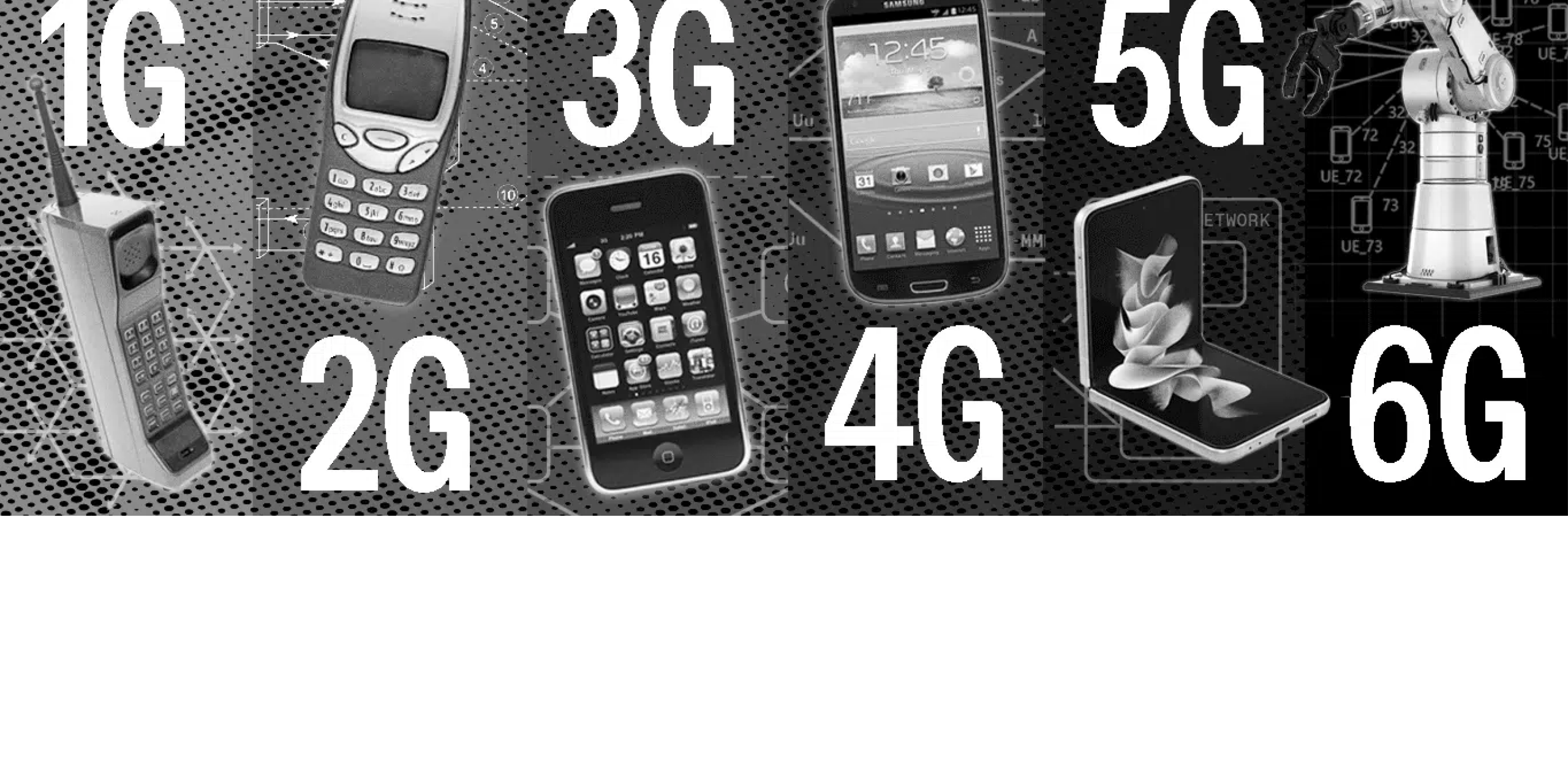
Every generation of mobile networks, from 1G to 5G, has rewritten the rules of how the world lives and works. The coming 6G revolution, by decade’s end, will represent a new direction still, toward a universal data fabric where millions of agents collaborate in real-time across the digital and physical worlds.
The story of wireless connectivity is often told in speeds and standards—megabits per second, latency, and spectrum bands. But these generational shifts in device specs obscure a deeper pattern. Each generation, from 1G to 5G, rewrote the relationships between three elements: the Devices we carry, the Networks that connect them, and the Applications that run on them. We call this connectivity’s DNA. With 6G, that DNA of interconnection is about to change fundamentally.
As with the “7 Phases of the Internet”—an article we published with IEEE Spectrum last October—mobile networks’ six generations follow a similar arc toward system-wide intelligence. That arc traces through every generation of wireless, revealing a steady advancement of the reach and scope of connectivity itself.
 SYLVANA MENESES; SOURCE IMAGES: ISTOCK
Devices: Bulky, expensive, analog phones
Networks: Circuit-switched systems dedicated exlusively to voice
Applications: Telephony, and telephony only
The first-generation networks of the 1980s did precisely one thing: carry voices without wires. Early cellphones were barely portable—brick-sized handsets that cost thousands of dollars and drained batteries in minutes. Networks like the Advanced Mobile Phone System (AMPS) used circuit-switching, dedicating an entire channel to each call, which meant capacity was scarce and expensive. The only application was the phone call.
Yet 1G’s modest achievement was revolutionary. Conversations could now move with the person having it. Communication detached from location. A salesperson could close a deal from their car. A doctor could be reached on the go. The technology was clunky and expensive, and the calls were only local. Nevertheless, the conceptual shift was real: The network would now follow the user, not the other way around. Every generation since has built on that remarkable insight.
SYLVANA MENESES; SOURCE IMAGES: ISTOCK
Devices: Bulky, expensive, analog phones
Networks: Circuit-switched systems dedicated exlusively to voice
Applications: Telephony, and telephony only
The first-generation networks of the 1980s did precisely one thing: carry voices without wires. Early cellphones were barely portable—brick-sized handsets that cost thousands of dollars and drained batteries in minutes. Networks like the Advanced Mobile Phone System (AMPS) used circuit-switching, dedicating an entire channel to each call, which meant capacity was scarce and expensive. The only application was the phone call.
Yet 1G’s modest achievement was revolutionary. Conversations could now move with the person having it. Communication detached from location. A salesperson could close a deal from their car. A doctor could be reached on the go. The technology was clunky and expensive, and the calls were only local. Nevertheless, the conceptual shift was real: The network would now follow the user, not the other way around. Every generation since has built on that remarkable insight.
 SYLVANA MENESES; SOURCE IMAGES: ISTOCK
Devices: Smaller, more affordable phones with better battery life
Networks: GSM, CDMA, and TDMA—digital networks that enabled global roaming
Applications: Texting (SMS) took off, becoming wireless’s first killer app
Wireless phones’ second generation, arriving in the 1990s, ushered in a quieter revolution: digitization. Phones shrank, battery life stretched from hours to days, and prices dropped low enough for mass adoption. Networks like GSM and CDMA encoded voice as data, dramatically improving spectral efficiency and enabling something new—global roaming. A handset purchased in Helsinki could work in Hong Kong.
But the big surprise was SMS. Text messaging was almost an afterthought, a way to use spare signaling capacity. Many users, especially younger ones, soon preferred it to voice calls. By decade’s end, billions of texts were crisscrossing the planet daily. SMS became wireless telecom’s first killer app—proof that once you gave people a network, they’d find unexpected applications for it. The lesson would repeat with every generation to come.
SYLVANA MENESES; SOURCE IMAGES: ISTOCK
Devices: Smaller, more affordable phones with better battery life
Networks: GSM, CDMA, and TDMA—digital networks that enabled global roaming
Applications: Texting (SMS) took off, becoming wireless’s first killer app
Wireless phones’ second generation, arriving in the 1990s, ushered in a quieter revolution: digitization. Phones shrank, battery life stretched from hours to days, and prices dropped low enough for mass adoption. Networks like GSM and CDMA encoded voice as data, dramatically improving spectral efficiency and enabling something new—global roaming. A handset purchased in Helsinki could work in Hong Kong.
But the big surprise was SMS. Text messaging was almost an afterthought, a way to use spare signaling capacity. Many users, especially younger ones, soon preferred it to voice calls. By decade’s end, billions of texts were crisscrossing the planet daily. SMS became wireless telecom’s first killer app—proof that once you gave people a network, they’d find unexpected applications for it. The lesson would repeat with every generation to come.
 SYLVANA MENESES; SOURCE IMAGES: ISTOCK
Devices: Early smartphones combined telephony with computing and cameras
Networks: Hundreds of kilobits-per-second bandwidth
Applications: Mobile email, browsing, and early app ecosystems
Third-generation mobile networks in the 2000s launched the mobile internet. In Japan, NTT DoCoMo’s i-Modeservice showed what was possible: a handset that could browse websites, check email, and download ringtones. Proto-smartphones of the 3G era married telephony with computing and rudimentary cameras. Networks like Wideband CDMA and EV-DO delivered speeds measured in hundreds of kilobits per second—horse-and-buggy speeds by today’s standards, but enough to make mobile email usable.
The applications that emerged hinted at a future still out of reach. BlackBerry became synonymous with executive productivity. Early app stores began to pop up. But screens were small, interfaces clunky, and coverage spotty. 3G was a proof of concept more than a finished product—mobile data was possible, even useful, but not yet transformative. The infrastructure was in place. What the world needed now was a device that could exploit it.
SYLVANA MENESES; SOURCE IMAGES: ISTOCK
Devices: Early smartphones combined telephony with computing and cameras
Networks: Hundreds of kilobits-per-second bandwidth
Applications: Mobile email, browsing, and early app ecosystems
Third-generation mobile networks in the 2000s launched the mobile internet. In Japan, NTT DoCoMo’s i-Modeservice showed what was possible: a handset that could browse websites, check email, and download ringtones. Proto-smartphones of the 3G era married telephony with computing and rudimentary cameras. Networks like Wideband CDMA and EV-DO delivered speeds measured in hundreds of kilobits per second—horse-and-buggy speeds by today’s standards, but enough to make mobile email usable.
The applications that emerged hinted at a future still out of reach. BlackBerry became synonymous with executive productivity. Early app stores began to pop up. But screens were small, interfaces clunky, and coverage spotty. 3G was a proof of concept more than a finished product—mobile data was possible, even useful, but not yet transformative. The infrastructure was in place. What the world needed now was a device that could exploit it.
 SYLVANA MENESES; SOURCE IMAGES: ISTOCK
Devices: Full-fledged smartphones became general-purpose computing platforms, with integrated GPS and app ecosystems
Networks: LTE delivered speeds up to 100x greater than 3G—making video streaming, maps, and video conferencing possible.
Applications: The app economy exploded, launching household names like Uber, Instagram, and WhatsApp
That device that could exploit the wireless network arrived with 4G. When long-term evolution (LTE) networks began rolling out around 2010, they delivered speeds an order of magnitude or more beyond 3G—fast enough to stream video, load maps instantly, and hold a video call without buffering. The network could now keep pace with what users wanted to do with it.
The smartphones that rode this wave were no longer communication tools with a few added features. 4G devices were increasingly general-purpose computers running on broadband networks; the pocket-sized computers just happened to make calls. High-resolution touchscreens, integrated GPS, accelerometers, and vast app ecosystemstransformed mobile devices into something new: a platform. The phone became a remote control for daily life.
And daily life reorganized around it. Uber turned any car into a potential taxi. Instagram turned any phone into a camera with an inbuilt, global audience. WhatsApp replaced SMS texting and, in some countries, the phone call itself. Netflix moved from the living room to the subway. The app economy minted millionaires and disrupted industries.
4G democratized access to computing and services—a supercomputer in every pocket, connected to everything. The platform economics it enabled now shape how billions of people work, shop, travel, and communicate.
SYLVANA MENESES; SOURCE IMAGES: ISTOCK
Devices: Full-fledged smartphones became general-purpose computing platforms, with integrated GPS and app ecosystems
Networks: LTE delivered speeds up to 100x greater than 3G—making video streaming, maps, and video conferencing possible.
Applications: The app economy exploded, launching household names like Uber, Instagram, and WhatsApp
That device that could exploit the wireless network arrived with 4G. When long-term evolution (LTE) networks began rolling out around 2010, they delivered speeds an order of magnitude or more beyond 3G—fast enough to stream video, load maps instantly, and hold a video call without buffering. The network could now keep pace with what users wanted to do with it.
The smartphones that rode this wave were no longer communication tools with a few added features. 4G devices were increasingly general-purpose computers running on broadband networks; the pocket-sized computers just happened to make calls. High-resolution touchscreens, integrated GPS, accelerometers, and vast app ecosystemstransformed mobile devices into something new: a platform. The phone became a remote control for daily life.
And daily life reorganized around it. Uber turned any car into a potential taxi. Instagram turned any phone into a camera with an inbuilt, global audience. WhatsApp replaced SMS texting and, in some countries, the phone call itself. Netflix moved from the living room to the subway. The app economy minted millionaires and disrupted industries.
4G democratized access to computing and services—a supercomputer in every pocket, connected to everything. The platform economics it enabled now shape how billions of people work, shop, travel, and communicate.
1G Connected Analog Voices
2G Merged Digital Voice with Messaging
3G Gave Mobile Data a Platform
4G Rolled Out a Completely Mobile Internet
Share Your Thoughts on this Article via our LinkedIn Thread!